Pecola's delusion of blue eyes
The Bluest EyePecola's delusion of blue eyes is the imagined fulfillment of a desire shaped by a racist beauty hierarchy, but it offers no rescue: believing she has acquired the blue eyes she longs for, she instead becomes more isolated from the people around her. In the closing conversation, her new eyes explain others' behavior to her; in the closing narration, the damage is described as total. The movement from intimate self-confirmation to public abandonment makes the delusion both a refuge and a measure of what the community has failed to protect.
The imagined change
Pecola speaks of her blue eyes as a fact already established. She tells her companion that Mrs. Breedlove now looks away from her, explaining that this has happened ever since she got the eyes. When asked whether Mrs. Breedlove might be jealous, Pecola accepts the possibility. In her account, a change in appearance has altered how others see her, and their averted gaze becomes evidence that the change is real.
The exchange makes the delusion relational rather than merely visual: Pecola does not only claim to possess blue eyes; she reads other people's behavior through that claim. Her companion allows the interpretation to stand, saying that the eyes are pretty. This brief agreement gives Pecola the recognition she seeks, even as the wider world supplies no corresponding acceptance.
Reassurance and repetition
The conversation repeatedly returns to looking. Asked what they should talk about, the pair settle on Pecola's eyes. She calls them her blue eyes and asks to look again; her companion says they become prettier each time. The repetition turns the imagined eyes into a shared subject and a small ritual of reassurance. Each look promises confirmation, and each compliment briefly sustains the story Pecola tells about herself.
That reassurance remains confined to the conversation. The companion's willingness to affirm the eyes does not change Pecola's circumstances or repair her relations with the community. The scene therefore holds tenderness and instability together: Pecola is not mocked in this exchange, but the comfort depends on repeatedly looking at and praising something that the closing narrative presents as part of her delusion.
Recognition and withdrawal
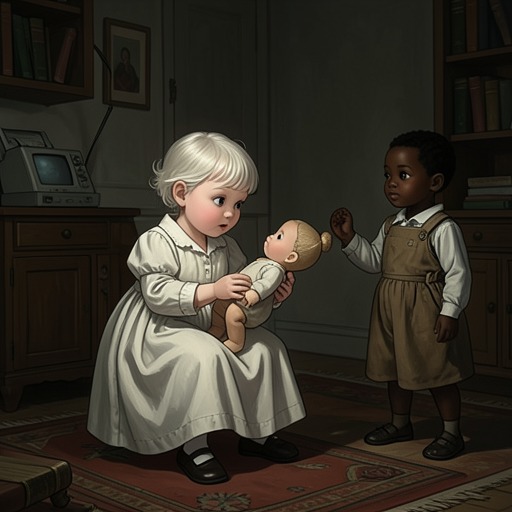
The narrative closes the distance between Pecola's account and the consequences visible to others. A little Black girl has yearned for the blue eyes of a little white girl, and the narrator says that the horror of the yearning is exceeded only by the evil of its fulfillment. The formulation is deliberately paradoxical: the desire begins in an ideal that makes Pecola's own appearance seem insufficient, while its imagined achievement brings no happiness or social recognition.
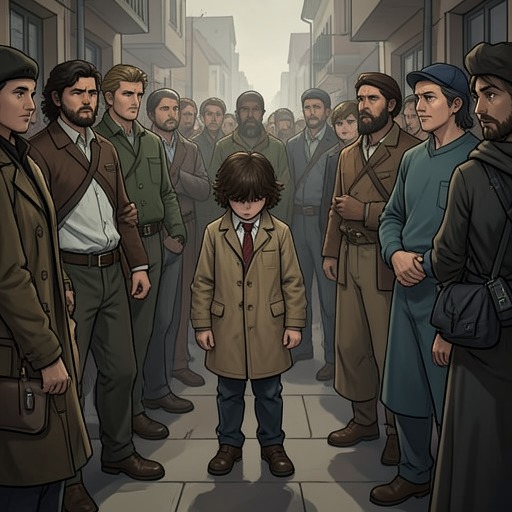
The people around Pecola do not respond with care. Grown people look away; children who are not frightened by her laugh outright. The narration calls the damage total and describes her walking up and down, her head jerking to the beat of a distant drummer. The repeated movement gives visible form to her isolation, while the adults' averted eyes echo the looking-away Pecola herself attributes to Mrs. Breedlove. What she interprets as jealousy belongs instead to a broader pattern of withdrawal and ridicule.
Narrative significance
The delusion dramatizes how the white ideal of beauty can shape not only what Pecola desires but also the terms in which she understands other people. Blue eyes become, in her account, proof that she has crossed into a condition worthy of attention. Yet the ending refuses to treat that imagined transformation as a cure: the community's response is avoidance and laughter, not the recognition she hoped the eyes would secure.
The contrast between the intimate exchange and the closing account is central to the state’s significance. In conversation, Pecola can name her eyes, invite another person to admire them, and receive agreement. Outside that small scene, adults turn away and children laugh. The reassurance is real as an interaction, but it cannot undo the social harm that has made the fantasy necessary. The ending leaves Pecola walking alone within a belief that offers her a form of confirmation while separating her further from shared reality and communal care.